
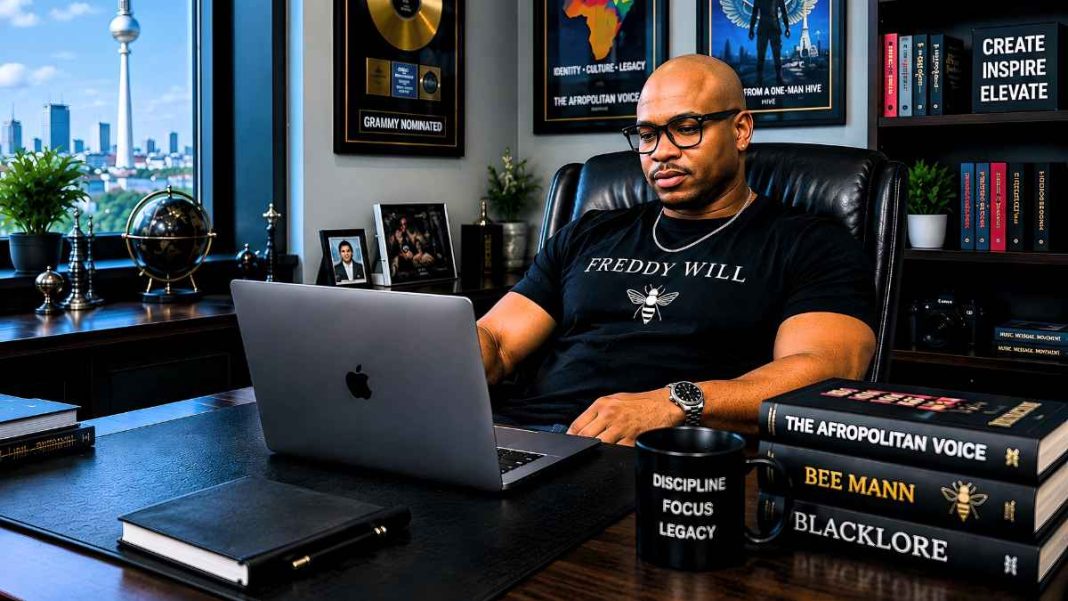


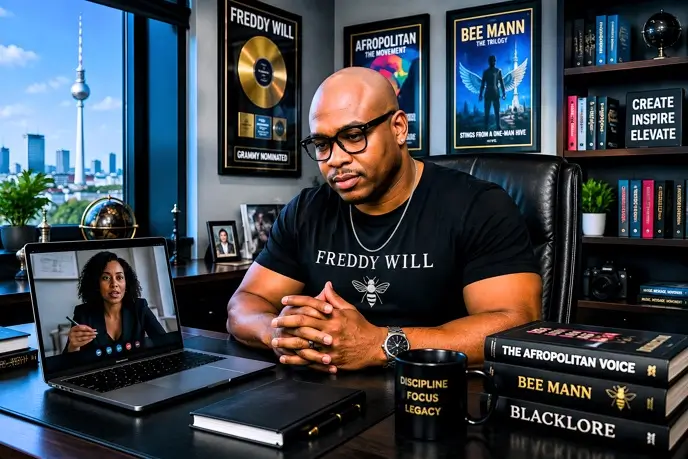
We connect with Freddy Will over Zoom on a settled evening here in California. On the other end of the call, a bright afternoon over Berlin, Germany, where this author is based, and he joins a few minutes late, laughing, phone still in hand from wrapping up something else. Before we get anywhere near the new visuals, I want to know who I’m talking to.
Freddy Will, born Wilfred Kanu Jr., is a Sierra Leonean-American author, emcee, and publisher whose work repeatedly returns to romance. From Brazenitout Volume 4, his exploration of feminism, to Theatre, Dance & Poetry: A Return to Love, a meditation on modern relationships, Freddy Will has built a body of work that treats intimacy, gender, and connection as subjects worth serious literary attention. His blog, Publik Discourze, continues that conversation.
In Bee Mann, romance isn’t a subplot. It’s structural. Bee Woman isn’t a supporting character. She’s the more consistent operator after Bee Mann, the one who gave Bee Mann his signature Rolex. She was a Hornet before she became his partner in the field. Their marriage is written as a partnership between equals under the same pressure, which Will says wasn’t accidental. Ahead of the visuals for his new single, Devils May Cry, he sat down with us to talk about where his vision of romantic partnership comes from, on the page and off it.
The Interview
Once he’s settled in, camera steady, I tell him what I want to talk about: not the mythology alone, but the man writing it. If he created the Bee Woman character with that much intention, I want to know what he thinks about love, dating, rejection, feminism, the women in his own life. He doesn’t hesitate. What follows is the edited conversation below.
What is dating to you?
The word has been commercialized. Today “dating” is tied more to restaurants, bars, nightclubs, and apps than to what the people involved intend. Years ago in the United States, I asked some people this same question. Some said dating is about getting to know someone, gauging personality, chemistry, and compatibility. Others used the same word for people who liked each other, who went out and spent time together, sometimes including intimacy. Neither of those is dating in my book, though this is simply how I define it, not a rule I’d impose on anyone else.
Look at the word: date. Two people agree on a time to meet and do something romantic together. I don’t think that should happen until you’ve known the person for a few weeks. Say I meet a woman for the first time in an elevator, and our conversation is good enough that we exchange numbers. We start talking via instant message, FaceTime, and calls. The first time we meet is not a date. That’s two people meeting for the first time. Coffee, a movie, a drink, even church together.None of that is a date either. That’s hanging out, but society blurs the line.
I date to marry. Those few weeks to months of talking aren’t just about killing time. It’s how we assess whether this is a match: expectations, mentality, habits, culture, personality. It either builds toward wanting more, or it tells us to walk away before anyone gets hurt. I’m a heterosexual man with a traditional mindset, and I think that pre-dating period is important because intimacy too early can leave someone feeling used once the “is this a match” question gets answered the hard way, on either side. So, during that pre-dating stage, I keep it simple: hold hands, a hello or goodbye hug, a light kiss on the cheek. It’s about building consistency.
You can still feel the chemistry that way, her hand on my arm, mine on the small of her waist, bodies lingering close, without rushing past the point where the connection has matured. None of it guarantees that the relationship will work out later. It’s just my protocol, not a formula for success. The real kiss, the one that means something, and everything after it comes later, in my book, after the official first date. Which, by then, is months after we met. By that time, this thing called love should begin to show its face. Venues and apps have a commercial reason to call every outing a date. That doesn’t make it one. But when the real one comes, it’s a milestone: that spark is real, and you both hope it becomes something more.
What is a relationship to you?
Here’s my map. The purpose of marriage is to start a family and raise children who become productive members of society. That’s hard work. You don’t enter a marriage expecting perfection or constant happiness. It’s a duty to God, to country, and to both families. Even so, there’s no point in all that duty if you never try to enjoy the journey. That’s why I believe it’s best to marry your best friend, and in my system, the roots of that friendship are planted in the pre-dating stage.
The stages look like this. Pre-dating, about three months: no lusting, just building fondness through conversation, interaction, and time together. Dating, six to eight months: this is when some intimacy naturally enters the picture, though it shouldn’t be the whole focus. It’s still your pre-marriage vetting period, so you don’t go all in sexually or financially. In my experience, many people I’ve talked to have told me they could tell within the first six months of dating, although there’s no way to really know for certain. A successful relationship is unpredictable.
Love and compatibility are crucial here. I advise restraint during the pre-dating stage, but once you’re dating steadily, I expect some intimacy, even if infrequent. I wouldn’t go into more adventurous territory while still vetting whether someone could be my wife, but the occasional intimacy or physical closeness is normal at this stage. If it starts to feel like something we need more consistently, that’s usually a sign it’s time to move from just dating to something exclusive. And if that pull continues past exclusivity, that’s usually another sign it’s time to marry.
The key is to know the difference between true love and feverish lust. You don’t want to spend your deepest intimacy on the wrong person, so the more intimate the romance becomes, the sooner marriage should follow. That said, when I’m choosing a fiancée, our intimacy matters to me directly. If it’s not where I need it to be, I’d reconsider, out of concern about walking into a sexless marriage. By eight months of steady dating, roughly twelve months after you first started talking, the next step should be clear. One of you asks the other to be your boyfriend or girlfriend. The answer should be wholehearted, not coerced.
At that point you become exclusive.That’s when I’d say you’re in a relationship: still best friends, still lovers, but now you’ve chosen each other as monogamous partners. I’d look for loyalty, cooperation, ambition, physical chemistry, culture, history, future goals, and financial intelligence as I enter this stage. The real question is simple: is this someone I can build a successful life with and run it until my dying day? A hard no can end it, unless the person saying no is willing to keep seeing each other casually, and the one saying yes is okay with that. Either way, the question should be asked, so both people know whether this is heading in the right direction.
I would try not to keep repeating this process with many people. Also, I wouldn’t advise having children at the boyfriend/girlfriend stage, even though many people do. And I also wouldn’t linger there. A husband or wife is more dignified than a boyfriend or girlfriend. When that relationship continues to go well, one of you should propose, get engaged, plan the wedding, and move into the husband-and-wife stage. You want to carry the early excitement into the marriage, rather than use it all up while you’re boyfriend and girlfriend. So, to answer the question: a relationship, to me, is when two people who’ve been dating decide to become monogamous partners.
What turns you on?
We’re talking romantically. When I was younger, physical appearance did it. A voluptuous woman could knock me off my square. As I got older, I realized that biologically everyone is much the same in body, with only small differences in height, size, and color. What turns me on now is personality, though I’ll be honest, it still starts with the facial expression. That’s probably why makeup and cosmetics are a billion-dollar industry. People assume I should be drawn first to a woman’s physique. In reality, it begins with her face or her cheeks. I can’t define it any better than that.Beauty is in the eyes of the beholder. I’m also drawn to long hair and different hairstyles.
After that comes her voice, a tone and manner of speaking that resonates with me in a way I can’t fully explain. It’s almost as if I lock into the way she sounds. I’m drawn to a calm energy.Heavy use of profanity or a lot of shouting isn’t for me. Too many tattoos and piercings personally aren’t my thing either, though that’s not a judgement on anyone who has them.Plenty of great preferences don’t share my taste. It’s just what does it for me. Clean nails, a pretty flat stomach, and normal teeth matter to me too, and so do feet, especially in open-toe heels or sandals.
That’s the combination that gets me: a face that’s easy on the eyes, long hair, and a voice I can only really identify when I hear it. Beyond that, I want intimacy and closeness, so I’m more drawn to a woman who pulls close to me than to chasing the other way around. When she wants me, I expect her to show it through her actions. I’m turned on by loyalty, cooperation, ambition, chemistry, respect, culture, peace, history, future goals, and financial intelligence. Put all of these in one word, and I’d say I’m turned on by her personality. That’s in the romance context, where I’m talking about the woman I’d spend the rest of my life with and raise a family with.
Who initiates?
Most of my past relationships began because the woman noticed and took the first step. Even on dating apps, women were usually the ones who started the conversation. I joke that I tend to choose the wrong one. When you put ten women in front of me, I’d probably pick the one least interested in me. But don’t be discouraged.My best relationships almost always started with the woman initiating and then meeting me halfway once I made my move. One ex laughed at everything I said during a baseball game until I finally noticed her. Another one shook everyone’s hand in a group until she reached me. That one turned out to be very experienced and bold, tho.
One woman wrote me a letter and had a kid deliver it. Usually, it starts small. A woman says hi in a certain voice, her expression and willingness align, and something shifts. Once I react, she texts or calls, and I respond with invitations. I’ve liked plenty of women I never asked out if the setting felt wrong, or I couldn’t tell whether they were single or interested. Approaching someone cold, with zero background, feels off. And when I do take that breath and go for it, I get turned down. But if the timing feels right.A smile, eye contact, a greeting. I’ll start a casual conversation.
Rejection?
Something most men experience often, and I’m no exception. In my early twenties, there was a woman I liked so much I’d stutter whenever I saw her, palms sweating, heart racing, dumbfounded. When she turned me down, it wrecked me. I couldn’t eat or sleep properly for nearly a week, and for weeks after that I kept wondering what might have happened if she’d said yes. Looking back now, shehad a lot of red flags I was too infatuated to consider at that time. Every encounter with her left me a little more shattered. I wanted to care for her, and her rejection hurt.
That’s the thing with love. It hurts when unreciprocated. A year later, I met someone far more compatible, someone who accepted me, and that’s when it clicked. Biologically, we’re all similar.What varies is the face and the personality behind the figure. That’s when I first started seeing rejection less as a wound and more as a kind of mercy, one that redirects you toward someone fitting. Years after that, another woman rejected me more gently but just as clearly. She told me, “Freddy, you’re a sweet guy. I would walk all over you.” That one stuck with me differently.
It taught me that some women bring a high-energy, demanding intensity that, even if I was drawn to her, could have been emotionally destructive. It’s better to choose the one who loves me than the other way around. Rejection hurts either way, but you learn to read what you’re actually being protected from. I’ve also noticed that the guys who always seem to have it figured out romantically are often carrying just as many scars as anyone else. They just don’t show it. Rejection isn’t something you outgrow. You just get better at recognizing when it’s doing you a favor.
When she says yes?
My system runs on a series of yesses, not just one. Each stage unlocks with its own answer, and each one is hers to give freely. I’m a man who values loyalty, peace, and continuity, so I pay attention to expression as much as words. The real expressions, not just a polite smile, tell me more than she might realize. The first yes is small. She gives me her number so we can talk. Later there’s a yes to spending time together, an activity, a dinner, eventually a trip. Each one opens the door a little wider to deeper interactions, more honesty about where I see things going. Keep in mind that these yesses also give the love the light it needs to bloom.
The bigger yesses come with stakes. One is when I ask her to be my girl, and she says yes. That’s when exclusivity begins, and I start opening more of my life. A key to my place, access to my phone, the trust reserved for family. I’d already been cooking for her during the dating stage, but once we’re exclusive, it becomes something more intentional.Regular candlelit dinners at home, just the two of us. Then there’s the yes to marriage, and finally the yes at the altar, when she’s asked if she’ll take this man as her husband, and she says it in front of everyone. There will always be someone with more money,power, resources, influence, or more to offer than me. But whatever falls within my means, once she says yes and keeps saying yes, becomes ours too.
Feminism?
We are talking about how Freddy Will perceives it. I say feminism today carries real institutional weight. It’s one of the fastest-spreading ideologies of our time. There are strands of it I genuinely respect: liberal, cultural, Black, eco, Marxist, socialist, postcolonial. I find myself more cautious around intersectional and trans feminism, still working through where I stand, and radical feminism is the strand I personally have the hardest time getting behind.
I also separate feminism from women’s rights, because I support women’s rights without reservation. Things like employment, financial stability, quality education, self-determination, security, and healthcare are among them. But feminism, as a movement, doesn’t have a single leader or a locked definition of what it’s fighting for. My own focus, when I write and think about this, is on the rights and experiences of women as I’ve encountered them across three continents, and that’s the lens I bring rather than any single ideological label.
In Sierra Leone, the priorities I’ve seen are access, education, financial inclusion, healthcare, and women pushing for basic income opportunities that should already be theirs. In Canada, the conversation moved toward self-determination and autonomy. Independence, consent, and sexual freedom carried the wind in the discourse there. In Belgium, Germany, and much of Western Europe, many of those earlier barriers have fallen, so the fight now is about the top, getting women into the managing director’s chair, the ministry, the CEO’s office. Watching those three realities up close, in the countries themselves, rather than from a headline, shaped my own position. It’s less about any single ideology and more about noticing what women actually need, and that need looks different depending on where the woman is standing.
Women’s rights?
I was pushing for women’s rights long before I heard the word feminism. That is the strangest part about my experience. I didn’t really encounter feminism as an idea until I lived in Canada, and the version I ran into first was the radical strand. Honestly, it caught me off guard. There was a real current of man-hate running through some of it, and that’s what sent me off to research feminism properly rather than react prematurely. That’s when I discovered the many strands.
Before any of that, my attention was already on women’s rights specifically. Through the Freddy Will Hope Foundation, we’d helped over 500 girls access secondary and university education. The unveiling of my Limited-Edition Postage Stamps, one of the proudest moments of my career, doubled as a fundraiser, and every dollar raised went directly to students in Liberia and Sierra Leone, all of them girls. You might not find me at a feminist rally. But when it comes to women’s rights specifically. Education, opportunity, protection. I’m there, front and center.
Women in your family?
The women who shaped me most weren’t always the ones closest by blood. My father’s sister, Aunt Isatu, lived in Bo and was a second mother to me. I’m not sure I’d have made it through that chapter of my life without her. I moved to Freetown, and she passed not long after I left Sierra Leone. I still feel that loss. My grandmother, Madam Beatrice Wusie, my mother’s mother, became a steady presence. She still has me out to London, still offers advice, keeps me looped into family politics. Both women were enough to me that when my daughter was born, I named her after them. Her middle names are both Isatu and Beatrice.
Some family bonds shift over the years,as they do for most people. Closeness with my mother and sisters has looked different. But my daughter Jasmine and her mother are central now. I’ve been in Jasmine’s life since she was born, and the day-to-day of raising her, the moments together, the trips to the studio, the time on the road for book tours, is some of the most grounding time I get. Beyond that, the women in my family are ambitious, hardworking, and family-oriented.Several hold senior positions in nursing. That thread runs through all of them, whatever the distance.
Your relationship with women, generally?
Most of the people around me, professionally and personally, have been women. My acting manager for close to ten years was a woman. Most of my hooks and background singers, the voices you hear across my albums, are women. Most of my staff and most of my fans are women too. That’s not something I planned. It’s just how my career has taken shape. Looking back on the romances that have mattered in my life, most of them began when the woman took the first step, and once that connection was there, they tended to move honestly.
When a woman gets close to me, it usually moves toward dating or a relationship, although that’s not always the case for everyone.Some encounters stayed where they were meant to, curiosity and mutual respect without needing to become anything more. Public life has brought its share of people who don’t wish me well.That’s simply part of the territory when you put your work and your story out into the world. But it hasn’t changed my chemistry with women, professionally, platonically, romantically. It has been one of the most consistent and honest parts of who I am.
On dating apps, whenever I used them, unless my account was shadow banned, as I suspect some of my accounts were restricted by a third party. The women there often reach out first, and we end up meeting in person. On certain platforms, it has felt as though someone tampered with my accounts to limit that visibility, because they know the women would make contact. Looking back, my relationships with women have generally been built on mutual curiosity and respect.
When most (not all) relationships with a woman end in real life, it is often because a third party advises the woman to step back. Whoever that third party is, they stay concealed. They pocket-watch me, anticipate my intentions, and make assumptions based on how comfortable the woman is around me. How readily she talks to me, befriends me, meets me, and establishes an easy rapport. Then they contact the woman, concoct a narrative, usually something negative, and spread that falsehood to weaken the connection she feels.
If you are a woman reading this: most people speaking badly to you about me quietly do not know me personally. They are not my friends, and they do not have first hand knowledge of my life or habits. Do not take their word. Especially when they tell you unproven rumors and ask you to keep it secret. They discourage you because they see your potential, and some might be envious that it is not with them. I believe my chemistry with women is strong—professionally, platonically, and romantically. When something does not work out, it is most often because third-party haters pressured her to withdraw, afraid she might offer me support or standing.
Honestly, I now date outside my community because of this. I don’t claim to be perfect or to never turn women off. Sometimes, I genuinely do something that causes rejection or abandonment. As I mentioned before, I often face rejection when approaching women. What I mean is that with the few women who do accept me and become friends or partners, most relationships tend to end due to third-party interference. I began dating outside my race and community to reduce this interference, trusting that with a real connection, the bond can be unbreakable.
The Bee Mann Rollout
Stings from a One-Man Hive, the first Bee Mann LP, was released on stream and vinyl by Swift Nightz Music Society in May 2026, followed a month later by Stings from a One-Man Hive II, the second LP. The companion book, Bee Mann: Stings from a One-Man Hive Book One, was published in July by Badson Publishing and distributed by African Books Collective. Books Two and Three are slated for 2027. Devils May Cry, the third LP, closes out the trilogy and launches on26November 2026. It’s the same book-plus-companion-album model that’s defined Freddy Will’s career since he began his career in Canada, but this time built around a mythology years in the making.
At the center of that mythology is the Colombian German Amira Will, the Bee Woman, and the author didn’t build her as a supporting character. “She’s not someone I invented to stand next to Bee Mann,” he says. “I invented her to demonstrate the romantic bond between a man and a woman, and in this mythology, she was a Hornet, a superhero sisterhood unit, before her husband was in the picture, an operator in her own right, more experienced than he was when they met. I wanted the story to reflect her culture and heritage. A lot of superhero fiction doesn’t have a wife and family written into the story at all. Others put the romantic partner on the sidelines. I built mine as someone who is both romantic and soft while also being formidable in the field.”
The Hornets themselves, an all-female unit, are a key element of the mythology. “Most women have a group of girlfriends or a sisterhood. Once I wrote Bee Woman’s backstory, the Hornets had to exist too, as her close friends. And once they existed, it felt wrong to make them less important to the plot. They make real contributions in this story.” For Freddy Will, the choice reflects values closer to his own life than to a plot device. “I wrote romance into Bee Mann the same way I have it in real life. Loyal partnership. The reader should walk away thinking of Bee Woman as a wife and mother and the Hornets as her girlfriends who will do anything for each other.”
The Visuals: Devils May Cry
By the end of our call, the conversation circled back to where it started: the new visuals, rolled out as a cinematic, still-frame sequence built around the title track. Freddy Will plays a Mansa Musa-like traveler, crossing the Sahara on camelback at the head of a golden caravan, an exceptional briefcase carried in his hand. We don’t yet know what’s inside it or where he’s going, only that it’s valuable enough to guard closely. It appears as if the character frequents there.
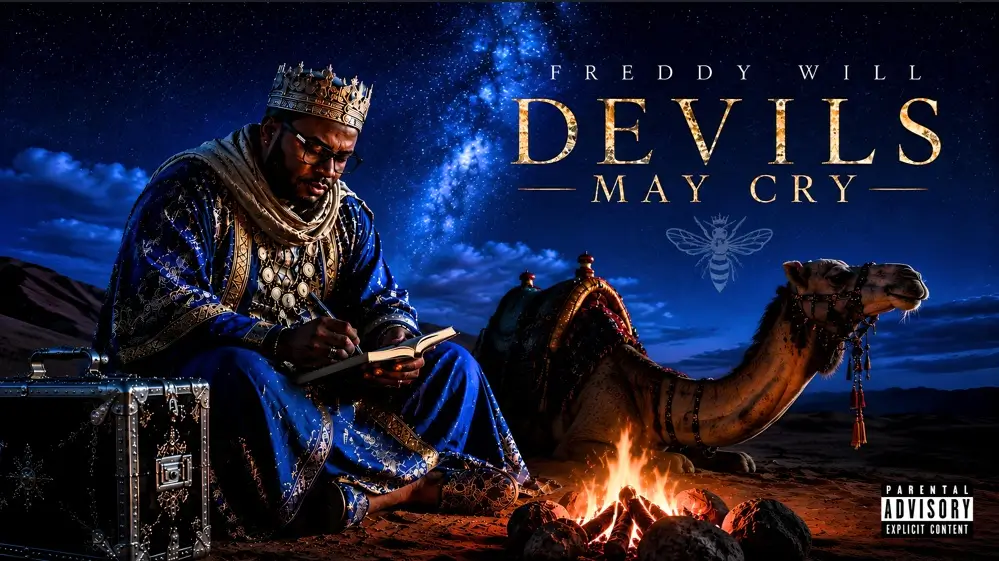
Thirty years of writing. The imagery ages him in real time. Gray hair, glasses, the weight of decades on the road, calling back to a Book One poem, Road Wins, his footprints stretching back to a horizon we never see the start of. At night, he writes by firelight. Whatever the desert does to him, the pen is how he processes it.The road tests him. Steep dunes. A luxurious desert encampment, women, market, music, all momentary temptations he passes without stopping.
On a lonely dune at twilight, his own shadow stretches out behind him, longer than he is, the devil you know made visible, not a literal demon, just the parts of himself he’s still wrestling with. Moments later, he’s seated in the sand, glasses in hand, head down. Even the strong ones break. Then the world shifts. He passes young men glued to their phones beside flashy cars, a generational contrast he watches. Then migrant families, on foot, modest possessions, a mother and child who catch his eye. Two very different encounters are happening in the same desert, and for the first time, he notices. The Traveler continues his long and tiring journey.
The oasis arrives like a mirage that turns out to be real.Palms, lanterns, tents, water, his wife Amira waiting for him in the distance. They embrace. But the briefcase never leaves his side.Even in the reunion, we know his journey isn’t over. The oasis settlement throws a celebration that night. Fire, food, barbecue, balaf on music, dancing, community. But mid-celebration, he steps away from the party, and his wife notices the shift in him before he says a word. Something is wrong, and he knows it. He ends the night in the arms of his wife.
At dawn, he watches more migrants moving on toward the Mediterranean. Everyone seems to be heading north. Before the sun is fully up, he kisses Amira goodbye and leaves, briefcase in hand, purpose now attached to the wealth he’s carried the whole film. He rushes to meet the North African traffickers holding the migrants, briefcase on the table, ready to pay their ransom. But the dock is already empty. He’s arrived too late. The crossing had begun long before he arrived.
The story’s emotional climax happens far from him. The same mother and child, now packed onto an inadequate vessel crossing the Mediterranean, Europe a rumor on the horizon, the Traveler nowhere near enough to reach them. And the closing says it plainly. Dawn on the shore, the wealth he brought sitting uselessly beside him, notebook still in hand. He didn’t stop it. But he’s the one who witnessed it and is still writing. We all have demons, and devils may cry.
Watch Devils May Cry
The full visual experience for Devils May Cry is available now on YouTube and Instagram. The single arrives ahead of the Devils May Cry LP, Freddy Will’s third Bee Mann album, launching 26 November 2026, with Books Two and Three of the Bee Mann series following in 2027. Freddy Will is currently booking live performances of all three albums for December. For more information, visit: www.freddywill.de.
YouTube:https://shorturl.at/AyY1e
IG:https://www.instagram.com/11th_freddywill_ofthesun/
Rumble: https://shorturl.at/ruJpt