

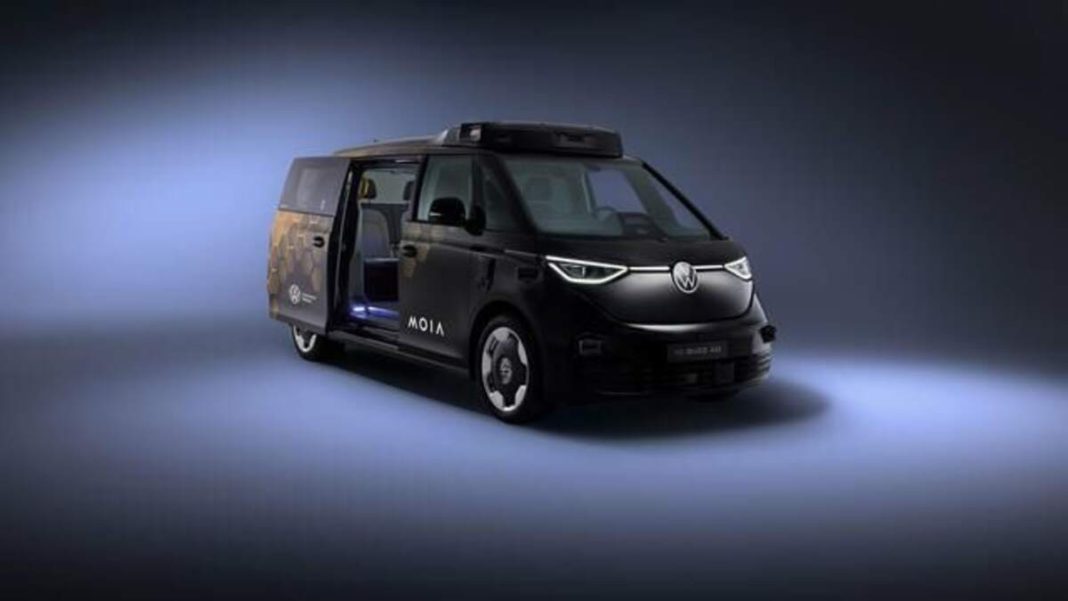


Volkswagen’s self-driving subsidiary has made a notable entry on U.S. pavement. On Thursday, MOIA America and cooperating Beep started shuttling invited guests in driverless carriages around Orlando’s Lake Nona neighborhood.
The service operates on custom-designed electric Volkswagen ID. Buzz vans with Mobileye’s Autonomous Driving system aboard. A human safety operator is present in the vehicle for the time being as the system gets tested on actual routes. Passengers are scheduled rides through the company’s app, Beep, and enjoyed on three fixed routes with defined stop locations in the development community. This tightly-controlled and constrained setting gives both firms a fine-grained understanding of user behavior with robotaxis.
Yet Paul DeLong, co-president of MOIA America, expressed the benefits of these initial treks. “Every journey gives us clarity, ” he told Quartz. “It gives us clarity into how people are going to live with the technology in their everyday lives.” That understanding will inform how the technology scales up and how fleet operators handle services.
It was a natural choice. Beep has run autonomous shuttles in the Florida suburb since 2019two years before the rest of the state began to loosen restrictions on self-driving vehicles. Lake Nona also is home to a robust transit system, and since Beep’s shuttles have been operating on it for years, Orlando already had a transportation infrastructure that the technology could mesh with.
This roll-out is one element of a broader strategic alliance announced in early 2018. Up to five thousand MOIA Americas-designated ID. Buzz self-driving vans are expected to operate in numerous U.S. markets over the coming decade, focused on public-transit or microtransit. As a package, the self-driving vehicle itself, the Mobileye self-driving platform, the mobility-as-a-service software platform, and operator training. While the day-to-day-running is the responsibility of Beep, the technology platform providers are MOIA.
Meanwhile MOIA America is busy on its on-road testing and validation in Los Angeles and Austin. These cities are like to join Orlando as the next launch markets once the company is prepared to kick-start commercial business from supervised passengers trips. But this cautious, step by step process simply echoes the industry reality. Companies including Waymo and Tesla already started to implement driverless taxi services in multiple US cities, while majority of still new players first and foremost maintained safety operators through their first public phase.
The ID. Buzz robotaxis are another layer of short-distance transportation for Lake Nona residents. The electrically powered van is loud in a good way perfectly suited for short trips, sharing space comfortably, and invented from the start to be used as a shared autonomous vehicle instead of converted from a previously used passenger car. Those audiences will be chosen by invitation, allowing riders to leap past anxieties about catching innovative vehicles on busy streets. The broader implication is the gradual sedimentation of autonomous mobility.